Topology-Agnostic Robotic Rebar Tying
Geometry-Structured Perception for Topology-Agnostic Robotic Rebar Tying
Huiguang Wang a, Zekai Jina, Yi Shao a,*
a McGill University, Montreal, Canada
* Corresponding author, email address: yi.shao2@mcgill.ca
Abstract
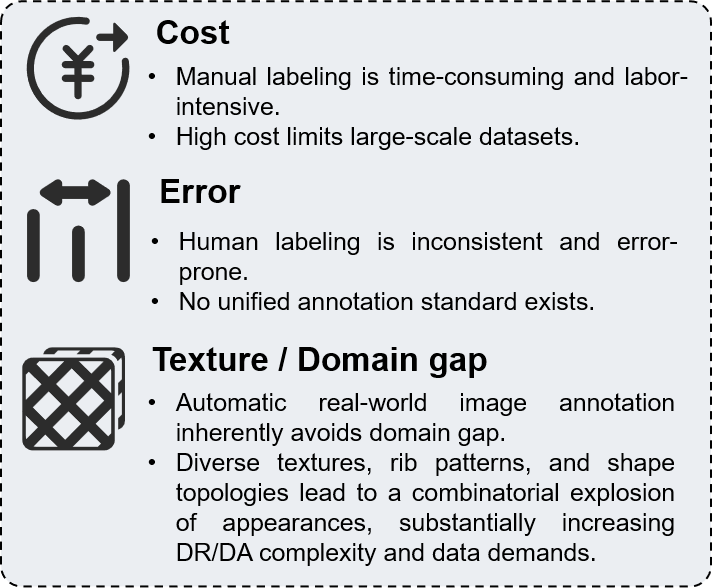
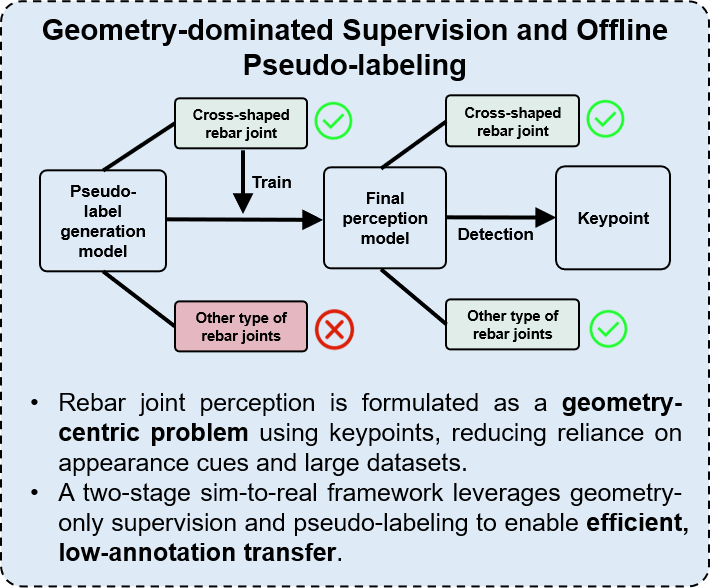
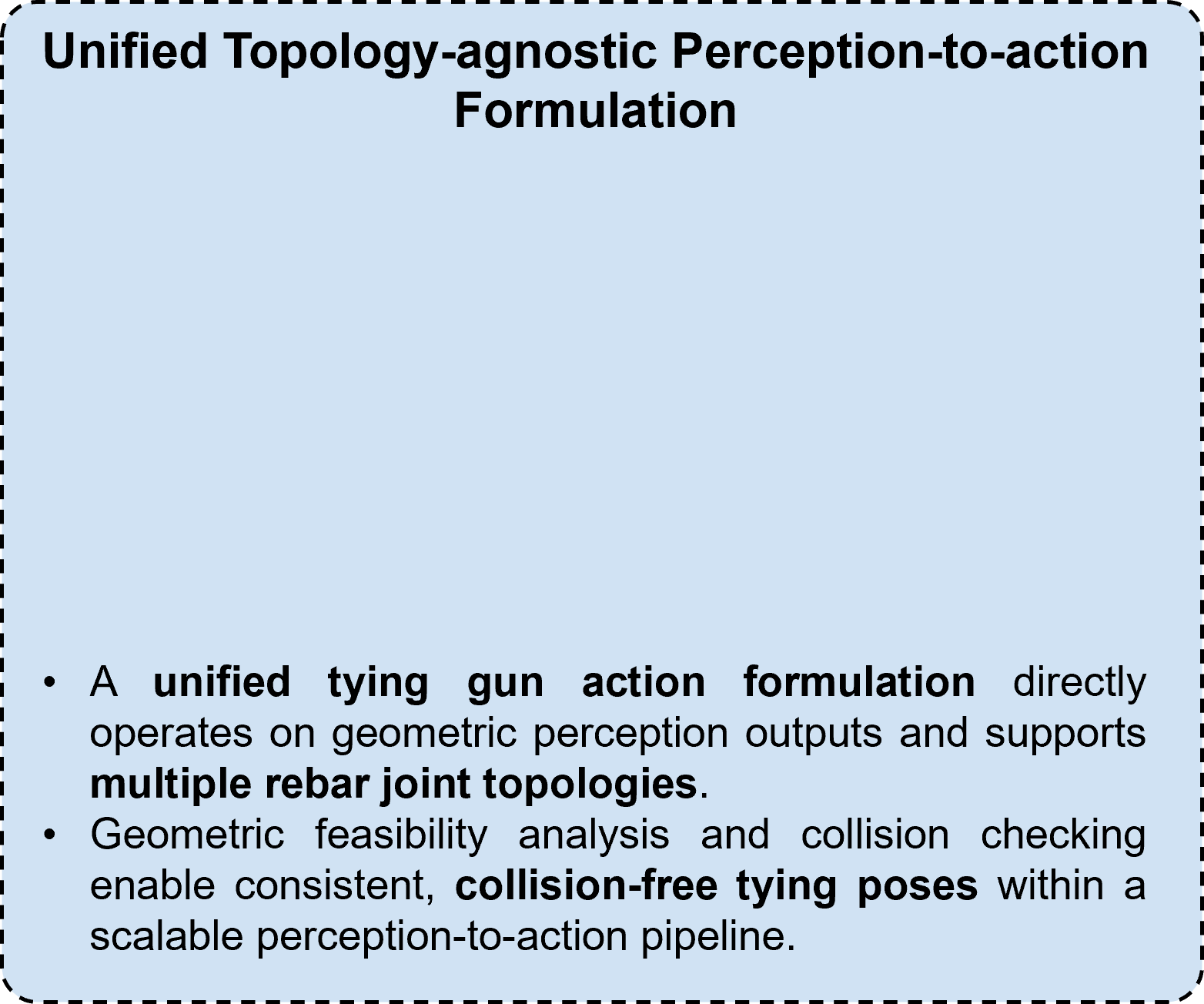
Robust perception of rebar joints is challenging due to geometric variability, irregular intersection topologies, and real-world sensing imperfections. Existing methods largely rely on appearance-driven recognition and topology-specific supervision, which limits generalization. We reformulate rebar joint perception as a geometry-dominated structural understanding problem and propose a two-stage learning pipeline that biases learning toward geometric invariants without explicit domain adaptation. In the first stage, a geometry-only synthetic dataset is constructed to train a detector that is used exclusively as a fixed annotator to generate reliable pseudo-labels for simple cross-shaped intersections in real images. In the second stage, a final perception model is trained from scratch using only these pseudo-labeled, background-removed real images, introducing authentic geometric variability without manual annotation or iterative self-training. Based on this formulation, we further design a unified, topology-agnostic perception-to-action pipeline for robotic rebar tying. Experiments demonstrate robust sim-to-real generalization across diverse rebar configurations with high data efficiency.
Keywords: Rebar tying automation; Geometry-structure-aware; Sim-to-real; Data-efficient; Robotic perception
Leave a comment